

Company Registration in India 2026: Fees, Process & Documents
Company Registration in India for Startups and Businesses
Types, Eligibility, Fees, Documents & Step-by-Step Process | 2026 Guide
Every business starts with an idea, but turning that idea into a company that can raise funds, sign contracts and hire a team requires formal registration. For most founders in India, registering a company is the first big legal step in building a serious business.
A registered company is recognised as a separate legal entity. It protects the personal assets of its owners, makes it easier to raise investment and builds trust with customers, vendors, banks and investors.
The good news is that company registration in India is now fully online. This guide explains the types of companies you can register, the eligibility requirements, government fees, documents required and the complete registration process, so you can incorporate your business with confidence.
1. What Is Company Registration?
Company registration, also called incorporation, is the legal process of creating a company with the Registrar of Companies (ROC) under the Ministry of Corporate Affairs (MCA). In India, companies are incorporated under the Companies Act, 2013, through the SPICe+ (Simplified Proforma for Incorporating Company Electronically Plus) form on the MCA portal.
Once registered, the company receives a Certificate of Incorporation with a unique Corporate Identity Number (CIN). From that date, the company exists as a legal person that can own property, enter into contracts, borrow money and sue or be sued in its own name.
Official portal: https://www.mca.gov.in/
2. Types of Business Structures in India
Choosing the right structure is the first decision. The most common options are:
Structure | Best suited for | Key feature |
Private Limited Company | Startups and businesses planning to raise funds or scale | Limited liability, easy to bring in investors and issue ESOPs |
One Person Company (OPC) | Solo founders who want limited liability | A single person can own and run the company |
Limited Liability Partnership (LLP) | Professional firms and service businesses | Partnership flexibility with limited liability and lighter compliance |
Public Limited Company | Large businesses raising money from the public | Can offer shares to the public, with stricter compliance |
Section 8 Company | Non-profit organisations | Profits must be used only to promote its charitable objects |
For most startups, a Private Limited Company is the preferred choice because it is the structure investors are most comfortable with and it is eligible for DPIIT startup recognition. The rest of this guide focuses on registering a Private Limited Company.
3. Eligibility Requirements for a Private Limited Company
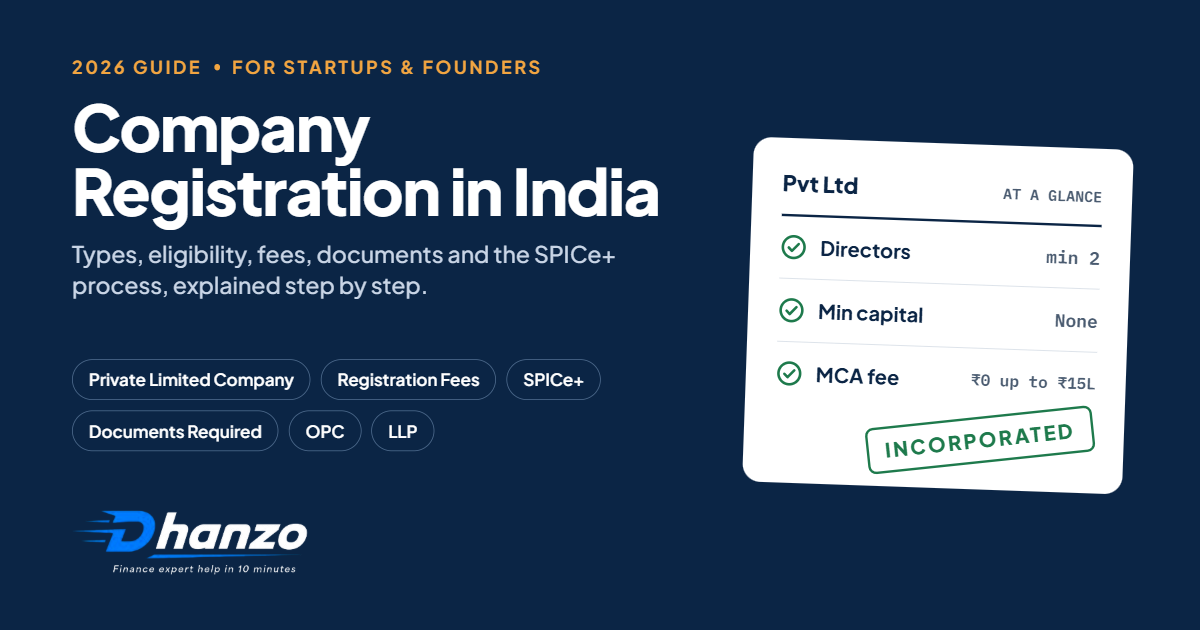
Directors: at least 2 directors, with a maximum of 15 (more can be appointed by a special resolution).
Resident director: at least one director must have stayed in India for 182 days or more during the financial year.
Shareholders: at least 2 and up to 200 members. Directors and shareholders can be the same people.
Capital: there is no minimum paid-up capital requirement.
Name: a unique name that is not identical or too similar to an existing company or registered trademark.
Registered office: an address in India where the company will receive official communication. A residential address can be used.
4. Benefits of Registering a Company
4.1 Limited liability
Shareholders are liable only to the extent of the unpaid amount on their shares. If the company faces losses or debts, the personal assets of the owners are generally protected.
4.2 Separate legal entity
The company exists independently of its owners. It can own assets, open bank accounts, enter into contracts and continue its business regardless of changes in ownership or management.
4.3 Easier fundraising
Angel investors and venture capital funds generally invest only in private limited companies, because shares can be issued, transferred and documented cleanly. Companies can also offer ESOPs to attract and retain talent.
4.4 Credibility and trust
A registered company’s details are publicly available on the MCA portal. Customers, vendors, banks and large clients often prefer to work with registered companies, which can open doors to bigger contracts.
4.5 Perpetual succession
The company continues to exist even if its directors or shareholders change, retire or pass away, which gives the business long-term stability.
4.6 Access to government benefits
A private limited company can apply for DPIIT startup recognition and the related tax and compliance benefits, as well as several government schemes and tenders open to registered entities.
5. Company Registration Fees in India
The total cost of registering a private limited company depends mainly on the authorised capital and the state of the registered office.
Cost component | Amount |
Name reservation (SPICe+ Part A or RUN) | ₹1,000 |
SPICe+ filing fee for authorised capital up to ₹15 lakh | Nil |
SPICe+ filing fee for authorised capital above ₹15 lakh | Slab-based, as per the MCA fee schedule |
Stamp duty on MoA and AoA | Varies by state and authorised capital |
Digital Signature Certificate (DSC) for each director | Charged separately by the certifying authority |
Professional fees | Charged separately by the service provider |
Keeping authorised capital at ₹15 lakh or less at the time of incorporation keeps the MCA filing fee at zero. The authorised capital can be increased later when the company needs to issue more shares, for example, during fundraising.
6. Documents Required for Company Registration
For directors and shareholders
PAN card (mandatory for Indian nationals).
Aadhaar card, passport, voter ID or driving licence as identity proof.
Address proof, such as a recent bank statement, electricity bill or mobile bill.
Recent passport-size photograph.
Email address and mobile number.
For the registered office
Recent utility bill, such as an electricity, water or gas bill, for the premises.
Rent agreement, if the premises are rented.
No Objection Certificate (NOC) from the owner of the premises.
For foreign nationals
A passport is mandatory, along with address proof. Documents generally need to be notarised or apostilled in the country of origin, as applicable.
7. Company Registration Process: Step by Step
Step 1: Obtain Digital Signature Certificates (DSC)
Every proposed director and subscriber needs a valid DSC to sign the incorporation forms electronically.
Step 2: Reserve the company name
Apply for the proposed name through SPICe+ Part A or the RUN service on the MCA portal. Once approved, the name is reserved for 20 days, within which the incorporation application must be filed.
Step 3: File SPICe+ Part B
Fill in the company details, registered office address, capital structure and details of directors and subscribers. Director Identification Numbers (DIN) are allotted through this form for up to three proposed directors who do not already have one.
Step 4: Draft the e-MoA and e-AoA
The Memorandum of Association (MoA) sets out the company’s objects, and the Articles of Association (AoA) set out its internal rules. Both are filed electronically along with SPICe+.
Step 5: Complete AGILE-PRO-S
This linked form is used to apply for GST registration (if required), EPFO, ESIC, professional tax registration in applicable states and the opening of a bank account for the company.
Step 6: Submit the application and pay fees
Attach the documents, sign the forms with DSCs, get them certified by a practising professional and pay the applicable fees and stamp duty online.
Step 7: Receive the Certificate of Incorporation
After the ROC verifies the application, the Certificate of Incorporation is issued with the company’s CIN. The company’s PAN and TAN are also allotted as part of the same process.
A clean application with an approvable name and correct documents is commonly processed within one to three weeks. Name rejections and document mismatches are the most common causes of delay.
8. Compliance After Company Registration
Incorporation is only the first step. A newly registered company must also complete these early compliances:
Compliance | Due date |
Open a bank account and deposit share subscription money | Soon after incorporation |
Hold the first board meeting | Within 30 days of incorporation |
Appoint the first auditor | Within 30 days of incorporation |
File INC-20A (declaration of commencement of business) | Within 180 days of incorporation |
Annual ROC filing (AOC-4 and MGT-7 or MGT-7A) | Every year, after the AGM |
Missing these early filings can attract penalties, and failing to file INC-20A can lead the ROC to initiate action to strike off the company.
9. Pro Tips for Founders: Common Company Registration Mistakes
Tip 1: Choose a unique name and check trademarks first
Names that are generic, too similar to existing companies or identical to registered trademarks are often rejected. Search both the MCA database and the trademark registry before applying, and keep a backup option ready.
Tip 2: Do not over-capitalise at incorporation
High authorised capital increases stamp duty and can attract MCA fees. Start with what you need and increase it later when you raise funds.
Tip 3: Keep documents consistent
Names, addresses and dates of birth must match exactly across PAN, Aadhaar and other documents. Even small mismatches can lead to resubmission requests.
Tip 4: Plan for post-incorporation compliance
Many founders celebrate the certificate and forget INC-20A, auditor appointment and annual filings. Put these dates in your compliance calendar from day one.
10. Conclusion: Build Your Business on a Strong Foundation
Registering your business as a company gives it a separate legal identity, protects your personal assets and makes it easier to raise funds, win customers and grow. With the fully online SPICe+ process and zero MCA filing fee for authorised capital up to ₹15 lakh, incorporation has never been more accessible.
The key is getting it right the first time: the right structure, an approvable name, consistent documents and a plan for the compliances that follow.
This is where Dhanzo can help. As India’s first quick finance service app, Dhanzo connects you with a verified finance expert within minutes, who handles your company registration from name approval to the Certificate of Incorporation while you track progress in real time on the app.
Ready to turn your idea into a registered company? Get your company registered with Dhanzo today.
Book company registration with Dhanzo: https://www.dhanzoapp.com/
Visit the official Dhanzo website: https://www.dhanzoapp.com/
Official Resources for Founders
Ministry of Corporate Affairs (MCA) portal: https://www.mca.gov.in/
Startup India: https://www.startupindia.gov.in/
Disclaimer: This article is for general informational purposes and is not legal advice. Fees, forms, eligibility conditions and procedures under the Companies Act, 2013 may change through amendments and MCA notifications. Verify the applicable requirements on the MCA portal or consult a qualified professional before applying.
Get it done with Dhanzo
The service this post is about.