
DPIIT Startup India Certificate 2026: Eligibility & Benefits
DPIIT Startup India Certificate
Eligibility, Benefits, Documents & Application Process | 2026 Guide
India’s startup ecosystem offers founders opportunities to access government support, protect intellectual property, participate in public procurement and explore funding programmes. One important step for eligible businesses is obtaining DPIIT Startup Recognition, commonly known as the Startup India Certificate.
Issued by the Department for Promotion of Industry and Internal Trade (DPIIT), under the Ministry of Commerce and Industry, this recognition establishes a startup’s eligibility to access various benefits under the Startup India initiative.
DPIIT recognition does not automatically grant every tax exemption, funding benefit or regulatory relaxation. Different benefits have separate eligibility requirements and application procedures.
1. What Is the DPIIT Startup India Certificate?
The DPIIT Startup India Certificate is an official Certificate of Recognition issued to eligible businesses under the Government of India’s Startup India initiative. Its purpose is to encourage entrepreneurship, innovation, employment generation and business scalability.
Recognition can help startups explore:
Tax benefits: eligibility to apply for a three-year income tax deduction under Section 80-IAC, subject to separate statutory conditions.
Regulatory benefits: self-certification under specified labour and environmental laws.
Intellectual property support: patent facilitation, faster patent processing and rebates on eligible filing fees.
Government procurement: relaxation from certain prior-experience, turnover and earnest money deposit requirements.
Funding opportunities: eligible startup investment initiatives, funding programmes and incubators.
Business credibility: formal recognition that can support applications to eligible government programmes and ecosystem initiatives.
Official portal: https://www.startupindia.gov.in/content/sih/en/startupgov/startup_recognition_page.html
2. DPIIT Startup Recognition: Eligibility Criteria
Founders should confirm that their business meets the prescribed legal structure, age, turnover and innovation requirements. The current framework reflects DPIIT’s notification dated 4 February 2026.
2.1 Company age
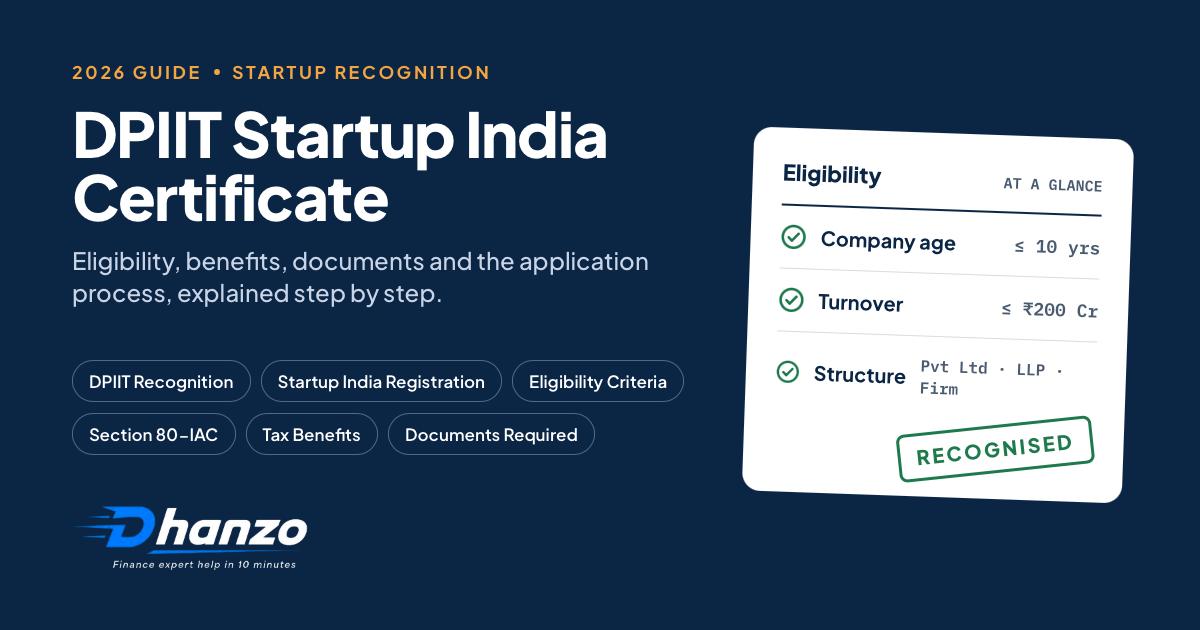
Regular startups: up to 10 years from incorporation or registration.
Eligible DeepTech startups: up to 20 years from incorporation or registration.
The 20-year period applies only to entities qualifying as DeepTech startups under the applicable framework; it is not automatic for every technology business.
2.2 Eligible business structure
Private Limited Company, incorporated under the Companies Act, 2013.
Registered Partnership Firm, registered under the Indian Partnership Act, 1932.
Limited Liability Partnership (LLP), registered under the Limited Liability Partnership Act, 2008.
Eligible cooperative societies, where covered by the applicable recognition provisions.
Sole proprietorships are NOT eligible for DPIIT Startup Recognition. Public limited companies are also outside the eligible structures under the standard recognition framework. A sole proprietor may need to establish an eligible legal entity before applying.
2.3 Annual turnover limit
Startup category | Maximum annual turnover |
Regular startup | ₹200 crore |
Eligible DeepTech startup | ₹300 crore |
The startup must not have exceeded the applicable threshold in any financial year since incorporation or registration. Crossing the threshold in an earlier year can affect eligibility even if current turnover is lower.
2.4 Originality of the business
The startup must not have been formed by splitting up or reconstructing an existing business. Merely transferring an established business into a newly incorporated company does not automatically make it eligible.
2.5 Innovation, improvement and scalability
The business must demonstrate at least one qualifying aspect:
Developing or improving a product, service or process.
Introducing innovation that addresses a problem or unmet customer need.
Operating a scalable business model with high potential for employment generation or wealth creation.
Innovation does not always mean creating entirely new technology. It may include a meaningful improvement in cost, speed, accessibility, efficiency, functionality or customer experience. Simply stating that a company provides a service, uses technology or operates online may not establish eligibility.
A strong application explains the problem, solution, innovation, scalability and potential impact, supported by evidence where relevant.
Additional requirements for DeepTech startups
DeepTech recognition is intended for businesses working on advanced scientific or engineering solutions. Relevant characteristics may include substantial R&D, significant intellectual property, long development timelines, high capital or infrastructure requirements, and scientific or technological uncertainty. The extended age and turnover thresholds depend on qualifying under the applicable criteria.
Official reference: https://www.startupindia.gov.in/content/dam/invest-india/Templates/public/Gazette_060226.pdf
3. Benefits of DPIIT Startup Recognition
3.1 Tax benefits and exemptions
Section 80-IAC: Three-year income tax deduction
Eligible DPIIT-recognised startups may apply for a deduction of 100% of eligible business profits for three consecutive assessment years, selected from the first ten years beginning with the year of incorporation. DPIIT recognition alone does not automatically grant this benefit.
Key conditions include:
The entity must be a Private Limited Company or LLP.
It must have been incorporated on or after 1 April 2016 and before 1 April 2030.
Turnover must not exceed ₹100 crore in the financial year relevant to the deduction.
It must hold the prescribed certificate of eligible business from the Inter-Ministerial Board of Certification.
It must satisfy the applicable innovation, business and statutory conditions.
The ₹100 crore Section 80-IAC limit is separate from the ₹200 crore regular recognition threshold and ₹300 crore DeepTech threshold. A separate application and approval are required.
Official reference: https://www.incometaxindia.gov.in/en/income-from-business/profession-taxation-of-start-ups
Angel tax: Important update
Angel tax was historically associated with Section 56(2)(viib) of the Income-tax Act, 1961. Section 56(2)(viib) was abolished with effect from 1 April 2025. It should not be presented as a current, generally available DPIIT benefit for transactions covered by the amended law. Seek tax advice for older investments or historical assessments.
3.2 Compliance and regulatory benefits
Eligible startups may self-certify compliance under six specified labour laws and three specified environmental laws, subject to the applicable framework.
For labour laws, routine inspections generally will not be conducted for five years, although inspections may follow a credible and verifiable written complaint approved through the prescribed process. Environmental benefits are narrower and apply to eligible industries classified in the relevant white category, subject to random checks and other conditions.
Self-certification does not remove statutory obligations. Startups must continue to comply with applicable laws and maintain appropriate records.
Easier winding up
Eligible startups may be able to use a faster exit process under the applicable insolvency framework. The fast-track insolvency resolution process has a prescribed period of 90 days and may be extended by 45 days under the relevant framework. This does not guarantee that every startup can close within 90 days; eligibility and circumstances matter.
3.3 Intellectual property (IP) benefits
Patent application support
Fast-tracking of eligible patent applications.
Assistance from government-empanelled IP facilitators.
An 80% rebate on eligible patent filing fees, subject to applicable rules.
The government bears prescribed facilitator costs under the relevant scheme. Startups remain responsible for statutory fees and other charges not covered by the scheme.
Trademark filing support
Eligible startups can receive a 50% rebate on applicable trademark filing fees, subject to the relevant rules. Trademarks protect brand identifiers, patents protect qualifying inventions, and copyright can protect qualifying original creative works. Recognition does not automatically register a trademark or grant a patent.
IP reference: https://www.startupindia.gov.in/santhali/content/sih/en/intellectual-property-rights.html
3.4 Government procurement and market access
Recognised startups may receive relaxations from certain public procurement requirements, including prior experience, prior turnover and Earnest Money Deposit (EMD), subject to applicable procurement rules and tender conditions. Technical specifications, quality standards and other mandatory requirements may still apply.
Explore opportunities through the Government e-Marketplace (GeM) and Central Public Procurement Portal (CPPP). Reference: https://www.startupindia.gov.in/santhali/content/sih/en/public_procurement.html
3.5 Funding and investment opportunities
Startup India Seed Fund Scheme
The scheme was designed to support eligible early-stage startups through selected incubators for proof-of-concept validation, prototype development, product trials, market entry and commercialisation. Funding is subject to scheme conditions and selection; DPIIT recognition alone does not guarantee support.
The official Seed Fund portal lists 31 May 2026 as the last date for startup applications. That date has passed, so check for a new application window before applying: https://seedfund.startupindia.gov.in/
Fund of Funds for Startups
The Fund of Funds for Startups supports startup financing indirectly through eligible Alternative Investment Funds (AIFs), which then invest in startups. Startup India Fund of Funds 2.0, notified in April 2026, has a corpus of ₹10,000 crore and is designed to channel capital through investment funds. It is not a direct government grant; startups generally approach participating funds and are assessed against their investment criteria.
Reference: https://www.startupindia.gov.in/content/dam/startupindia/Startup-India-Fund-of-Funds-2.0-Scheme.pdf
4. Documents Required for DPIIT Startup Recognition
Certificate of Incorporation or Registration, as applicable.
PAN details for the entity.
Directors’ or partners’ details requested by the portal.
A clear business description explaining the problem, solution, innovation and scalability.
A pitch deck or presentation covering the business model, product, target customers, differentiation and growth potential.
Product or service evidence such as a website, screenshots, prototype details, demonstrations, research or supporting material, where relevant.
Supporting business information such as incorporation date, turnover declarations and other details requested by the portal.
Applicant contact details, including a valid email address and mobile number.
The exact information and formats required may vary. Follow the current portal checklist. A useful pitch deck explains the problem, solution, innovation, business model, scalability and supporting evidence. The most important point is to substantiate why the business meets the innovation or scalability criteria.
5. Step-by-Step Application Process
The application is completed online through the National Single Window System (NSWS). There is no government application fee for DPIIT Startup Recognition.
Step 1: Visit Startup India
Go to https://www.startupindia.gov.in/ and review the recognition criteria and application instructions.
Step 2: Create an NSWS account
Visit https://www.nsws.gov.in/ and create an Investor Account if you do not already have one. Complete the requested account and business details.
Step 3: Select startup recognition
Open the NSWS dashboard.
Click Add Approvals.
Select Central Approvals.
Find Registration as a Startup.
Add the application to your dashboard.
Step 4: Complete the application form
Enter the legal entity, incorporation or registration, business activity and other requested details. Clearly explain the innovation, improvement or scalable model and its potential for employment generation or wealth creation.
Step 5: Upload documents and submit
Upload the Certificate of Incorporation or Registration and other documents requested. Verify that names, dates, PAN and declarations are accurate, documents are legible, and the business description is specific. Submit the application and retain the acknowledgement or reference number.
Step 6: Await DPIIT review
DPIIT may review the application and request additional information. Monitor the status and respond promptly to clarification requests. If approved, download the Certificate of Recognition through the relevant portal or official verification service.
Step 7: Explore benefits separately
Apply separately for Section 80-IAC tax benefits if eligible, explore IP facilitation, review procurement opportunities and check funding schemes or incubator programmes. Recognition is a gateway to eligible benefits, not automatic approval for all of them.
DPIIT has stated that it has not appointed an agency, representative or franchise to issue the certificate. Apply through the official portal and be cautious of anyone charging a purported government fee.
6. Pro Tips for Founders: Common Application Pitfalls
Tip 1: Make innovation clear, not implied
A vague description such as “We provide online services to businesses” does not explain innovation or scalability. Describe the problem, solution, improvement over existing alternatives and potential to scale. Where relevant, support the claims with product demonstrations, technical details, process improvements, customer evidence or research.
Tip 2: Check legal and financial information
Errors in incorporation details, PAN, entity names or declarations can trigger clarification requests. Cross-check the application against official records, verify the entity is eligible and ensure turnover and age fall within the applicable limits. Avoid unsupported claims about technology, intellectual property, customers or revenue.
Tip 3: Prepare for separate benefit applications
DPIIT recognition does not automatically grant the Section 80-IAC deduction, funding or every regulatory benefit. Section 80-IAC has separate conditions, including a ₹100 crore turnover threshold and certification requirements. Funding programmes have their own application windows and selection criteria.
7. Conclusion: Use DPIIT Recognition to Support Structured Growth
The DPIIT Startup India Certificate can be a valuable milestone for eligible businesses looking to protect intellectual property, explore government procurement and access startup support programmes.
A successful application starts with three things: meeting the eligibility criteria, maintaining accurate documentation and clearly demonstrating innovation or scalability. Once recognised, founders should actively explore the benefits that fit their business stage rather than assuming every benefit applies automatically.
Building a startup is challenging. Understanding and using the support available can make the journey more structured and help founders focus on building a sustainable business.
Simplify Your Startup Journey with the Dhanzo App
Getting your entity structure, innovation write-up, and pitch deck right the first time can save weeks of back-and-forth clarifications on the NSWS portal. With the Dhanzo App, founders can streamline everything from company incorporation and DPIIT documentation readiness to Section 80-IAC tax filings and ongoing statutory compliance all in one place.
Download the Dhanzo App today to handle the paperwork effortlessly while you focus on scaling your business.
Dhanzo Official Website: https://www.dhanzoapp.com/
DPIIT Certificate: https://www.dhanzoapp.com/services/startup-india-registration
Official Resources for Founders
DPIIT Startup Recognition: https://www.startupindia.gov.in/content/sih/en/startupgov/startup_recognition_page.html
DPIIT notification dated 4 February 2026: https://www.startupindia.gov.in/content/dam/invest-india/Templates/public/Gazette_060226.pdf
National Single Window System: https://www.nsws.gov.in/
Income Tax Department — Taxation of Startups: https://www.incometaxindia.gov.in/en/income-from-business/profession-taxation-of-start-ups
Startup India — Intellectual Property Rights: https://www.startupindia.gov.in/santhali/content/sih/en/intellectual-property-rights.html
Startup India — Public Procurement: https://www.startupindia.gov.in/santhali/content/sih/en/public_procurement.html
Startup India Seed Fund Scheme: https://seedfund.startupindia.gov.in/
Startup India Fund of Funds 2.0: https://www.startupindia.gov.in/content/dam/startupindia/Startup-India-Fund-of-Funds-2.0-Scheme.pdf
Disclaimer: This article is for general informational purposes and is not legal, financial or tax advice. Eligibility conditions, scheme availability and statutory requirements may change. Verify the applicable notifications and scheme guidelines before applying or claiming a benefit.
Get it done with Dhanzo
The service this post is about.