

GST Return Filing for Startups and Businesses
GST Return Filing for Startups and Businesses
Returns, Due Dates, Benefits of Timely Filing & Step-by-Step Process | 2026 Guide
Every GST-registered business in India has a recurring responsibility: reporting its sales, purchases and tax payments to the government through GST returns. For founders and small business owners juggling sales, hiring and operations, these deadlines can easily slip, and a missed return under GST is rarely just a small inconvenience.
Timely and accurate GST filing keeps late fees and interest away, protects your GST registration, preserves your right to claim Input Tax Credit and builds the kind of compliance record that customers, lenders and investors look for.
This guide explains what GST filing involves, which returns most businesses file, why filing on time matters and how the process works, so you can stay compliant without the last-minute stress.
1. What Is GST Filing?
GST filing is a mandatory compliance requirement under which a registered business officially reports its sales, purchases and tax details to the government. Returns are filed online through the GST portal at the frequency applicable to the taxpayer, usually monthly or quarterly, along with an annual return where required.
Through GST returns, a business reports:
Outward supplies: the sales made during the period, with invoice-level details for business customers.
Inward supplies: the purchases on which Input Tax Credit is being claimed.
Tax liability: the output tax payable after adjusting eligible Input Tax Credit.
Tax payment: the tax, interest and late fee paid through the electronic cash and credit ledgers.
Filing is required even when there is no business activity in a period. In that case, a nil return must still be filed by the due date.
Official portal: https://www.gst.gov.in/
2. Key GST Returns and Due Dates
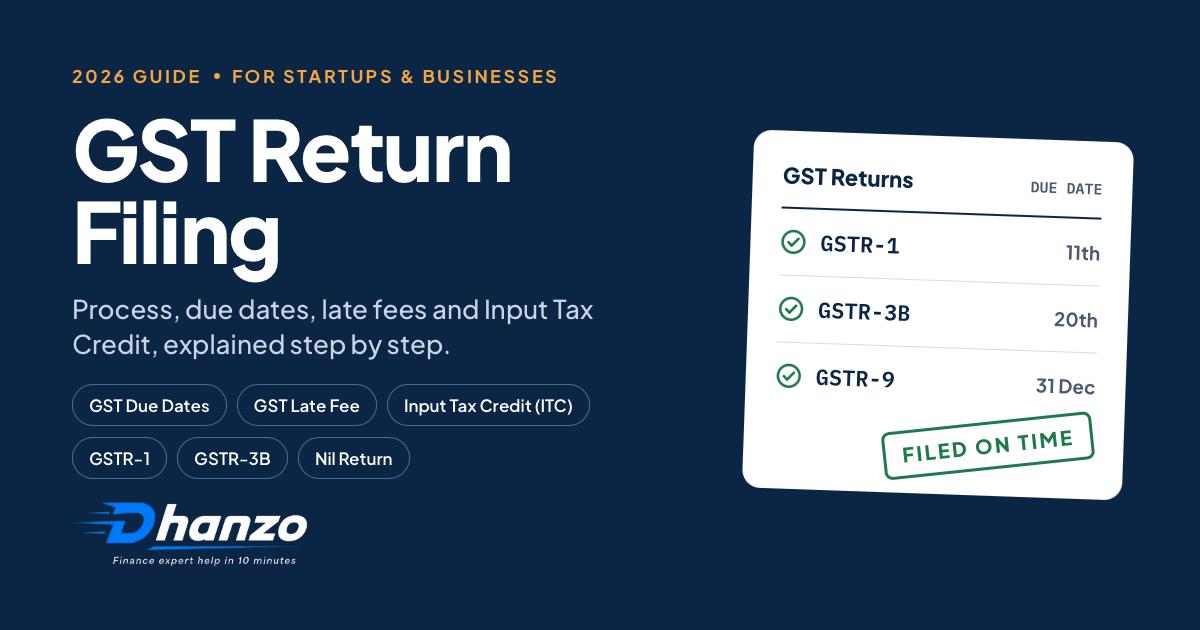
The returns a business files depend on its registration type and whether it has opted for the Quarterly Return Monthly Payment (QRMP) scheme or the composition scheme. The most common returns are summarised below.
Form/Return GSTR-1 | Description and Due Date Details of outward supplies (sales) | |
|---|---|---|
GSTR-3B | Summary of sales, Input Tax Credit and tax payment. | |
CMP-08 | Quarterly tax payment statement for composition taxpayers | |
GSTR-4 | Annual return for composition taxpayers | |
GSTR-9 | Annual return for regular taxpayers | |
Due dates can be extended by government notification, so always check the GST portal for the current deadline. Taxpayers with aggregate turnover up to ₹2 crore have been exempted from filing GSTR-9 for recent financial years through notifications; confirm whether the exemption applies to the year you are filing for.
3. Benefits of Timely GST Filing
3.1 Zero late fees and interest
The most immediate benefit of filing on time is avoiding avoidable costs. Under GST, late filing and late payment are charged on two separate meters: a late fee for filing the return after the due date, and interest for paying tax late.
Late fee for GSTR-1 and GSTR-3B
Type of return | Late fee per day | Maximum late fee per return |
|---|---|---|
Nil return | ₹20 (₹10 CGST + ₹10 SGST) | ₹500 |
Turnover up to ₹1.5 crore | ₹50 (₹25 CGST + ₹25 SGST) | ₹2,000 |
Turnover ₹1.5 crore to ₹5 crore | ₹50 (₹25 CGST + ₹25 SGST) | ₹5,000 |
Turnover above ₹5 crore | ₹50 (₹25 CGST + ₹25 SGST) | ₹10,000 |
The late fee is charged per return, so a business that misses several months pays it separately for each one. It must be paid in cash and cannot be set off against Input Tax Credit.
Interest on late payment
Interest at 18% per annum applies under Section 50 of the CGST Act on tax paid after the due date, calculated from the day after the due date until the date of payment, generally on the portion of tax paid in cash. Unlike the late fee, interest has no maximum cap, so on long delays it can quickly exceed the late fee.
3.2 An active and valid GST registration
Regular filing keeps your GST number valid. Under Section 29(2)(c) of the CGST Act, the proper officer may cancel the registration of a regular taxpayer who has not furnished returns for a continuous period of six months. Composition taxpayers face similar consequences for not filing within the prescribed period.
Missed returns can disrupt the business well before cancellation:
GSTR-1 for a period generally cannot be filed if GSTR-3B for the previous period is pending.
E-way bill generation can be blocked when returns are not filed for two consecutive tax periods, which can stop the movement of goods.
Customers may be unable to claim Input Tax Credit on your invoices, which can affect relationships and payments.
Returns generally cannot be filed after three years from their due date, which can leave old defaults permanently unresolved.
If a registration is cancelled for non-filing, restoring it usually requires filing all pending returns and paying the outstanding tax, interest and late fees within the prescribed time. Filing regularly avoids this situation altogether.
3.3 The right to claim Input Tax Credit (ITC)
Input Tax Credit allows a business to reduce its output tax liability by the GST already paid on eligible business purchases. In practice, this means legally recovering the tax paid on purchases instead of treating it as a cost.
Key conditions for claiming ITC include:
You must hold a valid tax invoice or other prescribed document.
You must have received the goods or services.
The supplier must have reported the invoice and it must appear in your GSTR-2B.
The supplier must have paid the tax charged to the government.
You must have filed your own GSTR-3B.
Payment must generally be made to the supplier within 180 days from the invoice date, or the credit must be reversed until payment is made.
ITC for a financial year must be claimed by 30th November of the following year or by the date of filing the annual return, whichever is earlier. Credit on certain items, such as specified motor vehicles, food and beverages and personal-use goods, is blocked under Section 17(5). Timely filing and regular reconciliation make sure eligible credit is not lost.
3.4 Business trust and credibility
Perhaps the most valuable long-term benefit is credibility. A business’s return filing history is visible to anyone who searches its GSTIN on the GST portal, and a consistent record signals that the business is well run.
Customers: business buyers often check a supplier’s filing status, since their own Input Tax Credit depends on it.
Lenders: banks and NBFCs commonly review GST returns when assessing business loans and working capital limits.
Investors: GST filings are a standard part of financial and compliance due diligence during fundraising.
Government programmes: many grant, subsidy and procurement processes ask for proof of tax compliance.
Regular filing does not guarantee funding or grant approval, but a clean compliance record removes a common obstacle when you apply.
4. GST Filing Process: Step by Step
GST returns are filed online through the GST portal. While the exact steps depend on the return, a typical monthly cycle for a regular taxpayer looks like this.
Step 1: Collect invoices and records
Gather all sales invoices, purchase invoices, credit and debit notes, and expense records for the period. Make sure every invoice carries correct GSTINs, tax rates and amounts.
Step 2: Reconcile purchases with GSTR-2B
Match your purchase register against the auto-generated GSTR-2B. Identify invoices your suppliers have not reported, mismatched amounts and ineligible credits before claiming ITC. This data matching step is where most errors are caught.
Step 3: File GSTR-1
Report outward supplies, with invoice-level details for business customers and summary details for consumer sales. Accurate GSTR-1 data allows your customers to claim their credit.
Step 4: Review GSTR-3B
Several liability fields in GSTR-3B are auto-populated from GSTR-1, and ITC fields from GSTR-2B. Review these figures, adjust eligible credits and confirm the net tax payable.
Step 5: Pay tax and file the return
Pay any balance liability, including interest and late fee where applicable, through the electronic ledgers, then file the return using a Digital Signature Certificate (DSC) or Electronic Verification Code (EVC).
Step 6: Save the acknowledgement
Download and keep the Application Reference Number (ARN) and filed return for your records. Track the next due dates so the following cycle starts on time.
Step 7: Complete annual compliance
At the end of the financial year, reconcile the year’s monthly or quarterly returns with your books and file the applicable annual return, such as GSTR-9 or GSTR-4.
5. Why Choose Dhanzo for GST Filing
The GST filing process involves careful record-keeping, reconciliation and tracking multiple deadlines every month. Dhanzo takes that work off your plate, so you can focus on running your business.
End-to-end handling: from reconciliation and data matching to final return filing, Dhanzo’s team handles the complete GST filing paperwork.
On-time filing: no more stressing about missed deadlines, late fees or interest.
Live status tracking: track the status of your GST filing in real time on the Dhanzo mobile app.
You share your records, and Dhanzo takes care of the rest until your GST return is successfully filed.
Official Dhanzo App Services: https://www.dhanzoapp.com/services
For more services visit the official Dhanzo App website and application: https://www.dhanzoapp.com/
6. Pro Tips for Founders: Common GST Filing Mistakes
Tip 1: Never skip nil returns
Many early-stage businesses assume that no sales means no filing. A nil return is still mandatory, and missing it attracts a late fee and counts towards the continuous non-filing that can lead to cancellation.
Tip 2: Reconcile every month, not at year-end
Waiting until the annual return to reconcile purchases with GSTR-2B often means discovering lost credit or supplier defaults when it is too late to fix them. A monthly reconciliation keeps your ITC claims accurate and defensible.
Tip 3: Check your suppliers’ compliance
Your ITC depends on your suppliers filing their returns and paying tax. Prefer suppliers with a consistent filing record, follow up on missing invoices in GSTR-2B and pay suppliers within 180 days to avoid credit reversal.
7. Conclusion: Make GST Compliance a Routine, Not a Risk
GST filing is more than a monthly formality. Filing on time protects you from late fees and interest, keeps your GST registration active, secures your Input Tax Credit and builds the credibility that supports your business’s growth.
The key is consistency: accurate records, regular reconciliation and filing before every due date. With the right support, GST compliance becomes a routine part of running your business instead of a recurring source of stress.
So what are you waiting for? Get your GST filing sorted today with Dhanzo.
Official Resources for Businesses
GST Portal: https://www.gst.gov.in/
GST Portal user manuals and tutorials: https://tutorial.gst.gov.in/
CBIC GST Acts, Rules and Notifications: https://cbic-gst.gov.in/
Disclaimer: This article is for general informational purposes and is not legal, financial or tax advice. GST rates, due dates, late fees and procedural requirements may change through notifications and amendments. Verify the applicable provisions on the official portals or consult a qualified professional before filing a return or claiming a credit.
Get these done with Dhanzo
The services this post is about.