

ROC Annual Filing 2026: AOC-4, MGT-7 Due Dates & Penalties
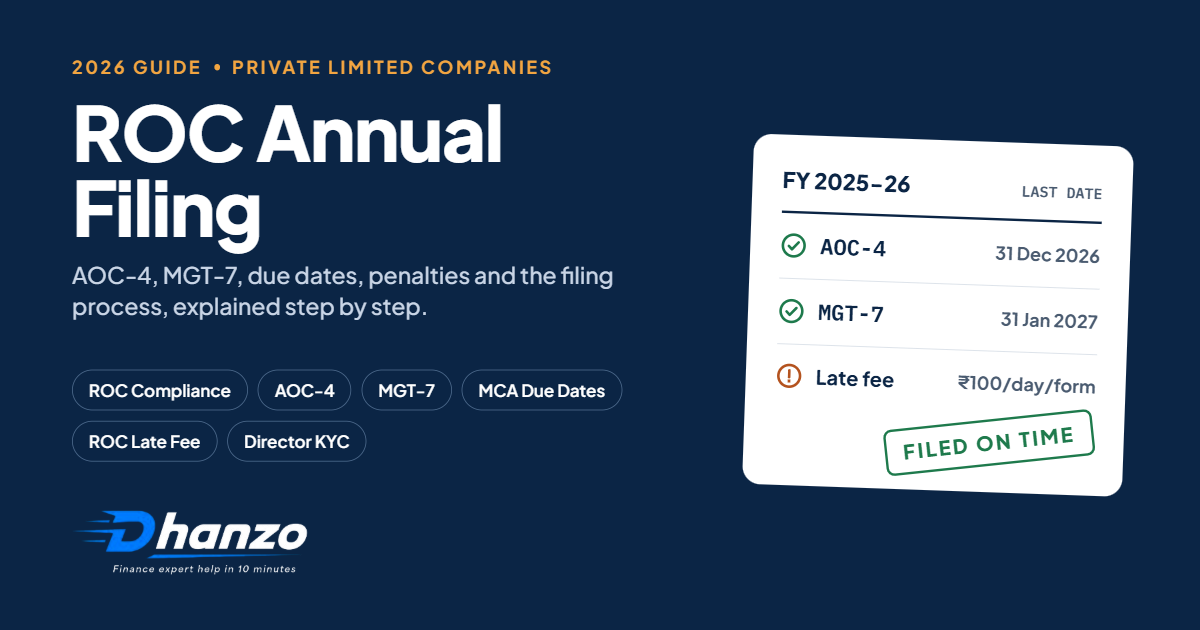
ROC Annual Filing for Private Limited Companies
AOC-4, MGT-7, Due Dates, Penalties & Step-by-Step Process | 2026 Guide
Registering a private limited company is only the beginning. Every year, the company must file its financial statements and annual return with the Registrar of Companies (ROC), whether it made a profit, a loss or had no business at all.
For founders focused on product, sales and fundraising, ROC deadlines are easy to miss. But the cost of missing them adds up quickly: additional fees of ₹100 per day per form, penalties on the company and its directors and, in serious cases, disqualification of directors or the company being struck off.
This guide explains what ROC compliance involves, the key forms and due dates, the latest MCA extension for FY 2025-26, the consequences of non-compliance and the step-by-step filing process, so your company stays in good standing.
1. What Is ROC ?
The Registrar of Companies is the authority under the Ministry of Corporate Affairs (MCA) that registers companies and LLPs and maintains their statutory records. ROC compliance refers to the filings that every company must make with the ROC under the Companies Act, 2013, through the MCA portal.
These filings fall into two groups:
Annual filings: financial statements and the annual return, which every company must file every year.
Event-based filings: forms filed when something changes, such as the appointment of a director or auditor, a change in registered office or an increase in share capital.
ROC filings are public records. Anyone can view a company’s filing history on the MCA portal, which makes regular compliance a direct reflection of how well the company is managed.
Official portal: https://www.mca.gov.in/
2. Who Must File Annual ROC Returns?
Annual ROC filing is mandatory for every company registered in India, including:
Private limited companies, including startups that are yet to start operations or generate revenue.
One Person Companies (OPCs).
Public limited companies and Section 8 (non-profit) companies.
There is no exemption for zero turnover. A company with no transactions during the year must still prepare financial statements, hold its AGM where required and file its annual forms.
3. Key Annual ROC Forms and Due Dates
Form | Purpose | Normal due date |
ADT-1 | Intimation of auditor appointment | Within 15 days of the AGM at which the auditor is appointed |
AOC-4 | Filing of audited financial statements | Within 30 days of the AGM |
MGT-7 / MGT-7A | Annual return (MGT-7A for small companies and OPCs) | Within 60 days of the AGM |
AOC-4 (OPC) | Financial statements of a One Person Company | Within 180 days from the close of the financial year |
The Annual General Meeting (AGM) must generally be held within six months of the end of the financial year, that is, by 30th September. The first AGM can be held within nine months of the close of the first financial year. For a company holding its AGM on 30th September, AOC-4 normally falls due on 29th or 30th October and MGT-7 by 29th November.
4. Latest Update: MCA Extends FY 2025-26 Filing Deadlines
Through General Circular No. 05/2026 dated 24th October 2026, the MCA has allowed companies to file their FY 2025-26 financial statements and annual returns without additional fees up to the following dates:
Forms | Relaxed date without additional fees |
AOC-4, AOC-4 (CFS), AOC-4 (XBRL), AOC-4 NBFC (Ind AS), AOC-4 CFS NBFC (Ind AS) | 31st December 2026 |
MGT-7 and MGT-7A | 31st January 2027 |
Keep two points in mind:
This relaxation covers additional fees for filing. It does not extend the deadline for holding the AGM.
If a form is filed after the relaxed date, additional fees are generally calculated from the original statutory due date, not from the relaxed date. Filing within the window is what counts.
5. Other ROC Filings Every Company Should Track
5.1 DIR-3 KYC for directors
Every individual holding a Director Identification Number (DIN) must complete KYC through Form DIR-3 KYC Web. From 31st March 2026, this is required once every three consecutive financial years, on or before 30th June, instead of every year. Directors who completed KYC for FY 2025-26 will next be due by 30th June 2028.
Any change in a director’s mobile number, email address or residential address must still be updated through DIR-3 KYC Web within 30 days of the change. A DIN can be deactivated if KYC is not completed.
5.2 Periodic and event-based filings
Form | When it applies | Due date |
INC-20A | Declaration of commencement of business for newly incorporated companies with share capital | Within 180 days of incorporation |
DPT-3 | Return of deposits and outstanding loans or money not treated as deposits | On or before 30th June every year |
MSME-1 | Payments outstanding to micro and small enterprise suppliers for more than 45 days | Half-yearly: 30th April and 31st October |
DIR-12 | Appointment, resignation or change in designation of a director | Within 30 days of the change |
6. ROC Compliance for LLPs
Limited Liability Partnerships follow a separate annual filing cycle under the LLP Act, 2008:
Form | Purpose | Due date |
Form 11 | Annual return of the LLP | On or before 30th May |
Form 8 | Statement of Account and Solvency | On or before 30th October |
Late filing of LLP forms also attracts an additional fee of ₹100 per day per form, with no maximum limit.
7. Consequences of Missing ROC Deadlines
7.1 Additional fees of ₹100 per day
Forms filed after the due date attract an additional fee of ₹100 per day of delay for each form. There is no upper limit, so a company that delays both AOC-4 and MGT-7 by a year can face additional fees of over ₹70,000, besides the normal filing fees.
7.2 Penalties on the company and its officers
Separately from additional fees, non-filing of financial statements and annual returns can attract penalties under Sections 137 and 92 of the Companies Act on the company as well as on its directors and officers in default.
7.3 Disqualification of directors
Under Section 164(2), if a company fails to file its financial statements or annual returns for three continuous financial years, its directors can be disqualified from being reappointed as directors of that company or appointed in any other company for five years.
7.4 Strike off of the company
Under Section 248, the ROC can initiate action to strike off a company that is not carrying on business or operations. Prolonged non-filing is a common trigger for such action, after which reviving the company requires a time-consuming and costly legal process.
8. Benefits of Timely ROC Filing
Active company status: your company remains “Active” on the MCA portal and avoids strike-off proceedings.
No avoidable costs: on-time filing saves additional fees and penalties that grow every day.
Smooth fundraising: investors review ROC filings during due diligence, and gaps can delay or derail a funding round.
Easier access to loans: banks and NBFCs rely on filed financial statements when assessing credit applications.
Protected directors: regular filing keeps directors clear of disqualification under Section 164(2).
Business credibility: customers, vendors and partners can verify your company’s compliance status on the MCA portal.
9. ROC Annual Filing Process: Step by Step
Step 1: Close the books and prepare financial statements
Finalise the accounts for the financial year and prepare the balance sheet, profit and loss statement and notes, along with the cash flow statement where applicable.
Step 2: Complete the statutory audit
Every company, irrespective of turnover, must have its financial statements audited by a chartered accountant. The auditor issues the audit report.
Step 3: Hold the board meeting
The board approves the audited financial statements and the board’s report, and calls the AGM.
Step 4: Hold the Annual General Meeting
Shareholders adopt the financial statements and, where applicable, appoint or reappoint the auditor. OPCs are not required to hold an AGM.
Step 5: File ADT-1
Where an auditor is appointed or reappointed at the AGM, file ADT-1 within 15 days.
Step 6: File AOC-4
File the financial statements, auditor’s report and board’s report in AOC-4, digitally signed by a director and certified by a practising professional where required.
Step 7: File MGT-7 or MGT-7A
File the annual return with details of shareholding, directors, meetings and other prescribed information.
Step 8: Save acknowledgements and check status
Download the filing receipts (SRNs) and confirm that the forms are approved and reflected in the company’s master data on the MCA portal.
10. How Dhanzo Helps with ROC Compliance
ROC compliance involves coordinating accounts, audits, meetings and multiple forms across the year. Dhanzo’s experts manage the process for you, so you can focus on growing your company.
Compliance calendar: tracking every ROC due date for your company and directors.
Documentation: preparing board and AGM documents and the required attachments.
Form filing: filing ADT-1, AOC-4, MGT-7 or MGT-7A and event-based forms on the MCA portal.
Status tracking: monitoring your filings until they are approved.
11. Pro Tips for Founders: Common ROC Filing Mistakes
Tip 1: Do not skip filing because the company had no business
A company with zero revenue still has to file AOC-4 and MGT-7. Many early-stage startups fall into default this way and face additional fees years later when they raise funds or apply for loans.
Tip 2: Do not confuse a fee waiver with an AGM extension
MCA relaxations usually waive additional fees for a limited period. They do not extend the AGM deadline. Hold your AGM on time and then use the relaxation window for filing if needed.
Tip 3: Keep DSCs valid and director details updated
Every ROC form must be signed with a valid Digital Signature Certificate. Expired DSCs and outdated director KYC details are among the most common causes of last-minute delays.
Tip 4: Track event-based filings through the year
Changes such as a new director, a change in registered office or an increase in authorised capital have their own deadlines. Missing them attracts the same daily additional fees.
12. Conclusion: Keep Your Company in Good Standing
ROC annual filing is not optional, and it is not only for large companies. Every private limited company must file its financial statements and annual return every year, and the costs of delay grow every day.
With the MCA relaxation for FY 2025-26, companies have until 31st December 2026 for AOC-4 and 31st January 2027 for MGT-7 without additional fees. Use this window wisely, but plan ahead so next year’s filings are completed on time.
This is where Dhanzo can help. As India’s first quick finance service app, Dhanzo connects you with a verified finance expert in 10 minutes, who takes care of your ROC filings from start to finish while you track progress in real time on the app.
The application is now available on IOS and Android.
Don’t let ROC deadlines catch you off guard. Get your ROC compliance sorted with Dhanzo today.
Book ROC compliance with Dhanzo: https://www.dhanzoapp.com/
Official Resources for Companies
Ministry of Corporate Affairs (MCA) portal: https://www.mca.gov.in/
Disclaimer: This article is for general informational purposes and is not legal advice. Due dates, fees, penalties and procedures under the Companies Act, 2013 and the LLP Act, 2008 may change through amendments and MCA circulars. Verify the applicable requirements on the MCA portal or consult a qualified professional before filing.