

Trademark Registration India 2026: Fees, Process & Class
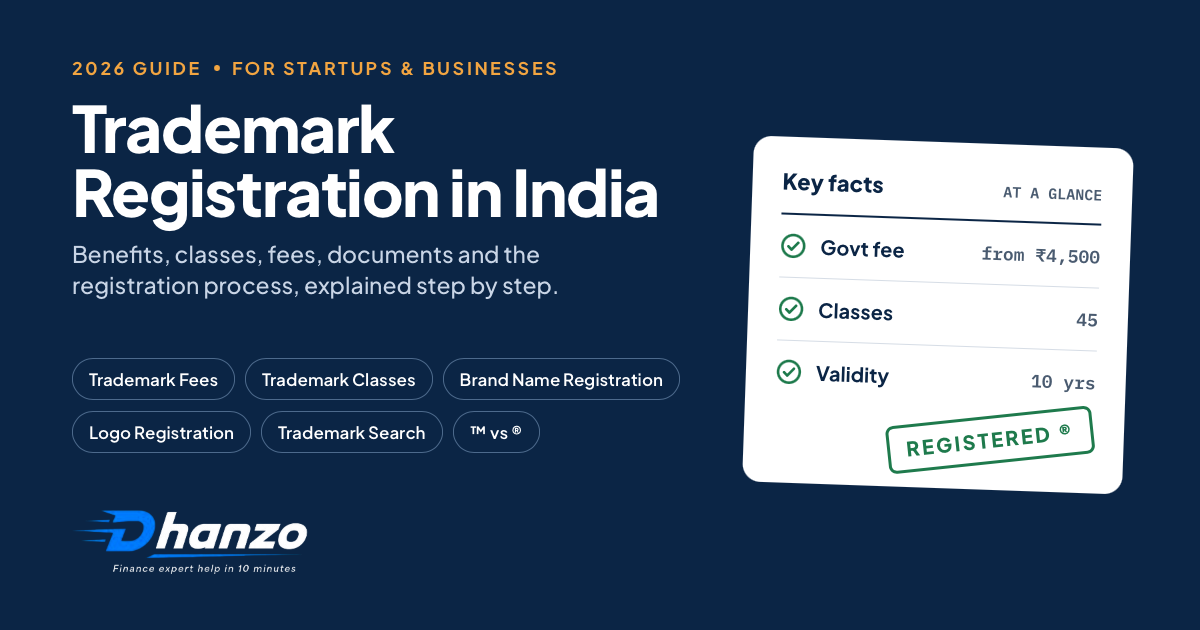
Trademark Registration in India for Startups and Businesses
Benefits, Classes, Fees, Documents & Step-by-Step Process | 2026 Guide
Your brand name, logo and tagline are often the first things customers remember about your business. As a startup grows, so does the value of that identity, and so does the risk of someone else using a similar name to confuse customers or ride on your reputation.
Trademark registration gives you legal ownership of your brand in India. It allows you to stop others from using a deceptively similar mark, take action against infringement and build an intangible asset that can be licensed, assigned or valued during fundraising.
This guide explains what a trademark is, what can be registered, the benefits of registration, the government fees, documents required and the complete registration process, so you can protect your brand with confidence.
1. What Is a Trademark?
A trademark is a mark that identifies the goods or services of one business and distinguishes them from those of others. In India, trademarks are governed by the Trade Marks Act, 1999 and the Trade Marks Rules, 2017, and registrations are handled by the Trade Marks Registry under the Office of the Controller General of Patents, Designs and Trade Marks.
Common types of marks that can be registered include:
Word marks: a brand name, product name or company name written in plain text.
Device marks: a logo, symbol or stylised design.
Taglines and slogans: distinctive phrases used with your goods or services.
Other marks: combinations of words and designs, shapes of goods, packaging, colour combinations and, in some cases, sound marks.
Registration is not compulsory, but an unregistered mark is much harder to protect. A registered trademark serves as prima facie evidence of ownership, which makes enforcement significantly easier.
Official website: https://ipindia.gov.in/
2. ™ vs ®: What Is the Difference?
Symbol | Meaning | When it can be used |
™ | Trademark claimed, not necessarily registered | Any time, including while the application is pending |
® | Registered trademark | Only after the registration certificate is issued |
Using the ® symbol before registration amounts to falsely representing a mark as registered, which is an offence under Section 107 of the Trade Marks Act. Until your mark is registered, use ™.
3. Benefits of Trademark Registration
3.1 Exclusive right to use your brand
A registered trademark gives the owner the exclusive right to use the mark for the goods or services it is registered for, across India. Others are restricted from using an identical or deceptively similar mark for the same or related offerings.
3.2 Legal protection against infringement
Registration allows the owner to file an infringement action against anyone who uses the mark without permission. Without registration, a business must rely on a passing off action, which requires proving reputation and goodwill and is generally harder to establish.
3.3 Brand trust and recognition
A protected brand helps customers recognise your products and services and signals that your business is established and serious about its identity. This consistency builds trust over time.
3.4 A valuable business asset
A registered trademark is intangible property. It can be sold, assigned, licensed or franchised, and it is often reviewed by investors during due diligence. A clear trademark position can strengthen your valuation and avoid disputes later.
3.5 Protection for 10 years, renewable indefinitely
A trademark registration is valid for 10 years from the date of application and can be renewed every 10 years, so your brand can stay protected for as long as you keep renewing it.
4. Trademark Classes: Choosing the Right Category
India follows the international Nice Classification, which divides goods and services into 45 classes. Classes 1 to 34 cover goods and classes 35 to 45 cover services. Your trademark is protected only for the classes and items you register it in.
Business type | Commonly relevant classes |
Software and SaaS products | Class 9 (downloadable software) and Class 42 (software as a service, IT services) |
Clothing and fashion brands | Class 25 (clothing, footwear, headgear) |
Food and beverage brands | Classes 29, 30 and 32, depending on the products |
Restaurants, cafés and cloud kitchens | Class 43 (food and drink services) |
Consulting, marketing and business services | Class 35 (advertising, business management) |
Financial and insurance services | Class 36 (financial and monetary affairs) |
These are common examples only. Many businesses need protection in more than one class, and a separate fee is payable for each class. Review your current offerings and planned expansions before deciding.
5. Trademark Registration Fees
Government fees for filing an application in Form TM-A are charged per mark, per class.
Applicant category | E-filing | Physical filing |
Individual, startup or small enterprise | ₹4,500 | ₹5,000 |
All other applicants | ₹9,000 | ₹10,000 |
The lower fee applies to individuals, recognised startups and small enterprises, supported by the relevant proof, such as a DPIIT recognition certificate or Udyam registration. Renewal in Form TM-R costs ₹9,000 by e-filing for each class. Professional fees, if you use an agent or service provider, are charged separately.
6. Documents Required for Trademark Registration
Applicant details: name, address and nationality or entity type of the applicant.
Brand details: the word mark, and a clear image of the logo if registering a device mark.
Goods or services: an accurate description of what the mark will be used for, and the classes selected.
Date of first use: the date from which the mark has been used in India, or a statement that it is proposed to be used.
User affidavit: supporting evidence where prior use of the mark is claimed.
Entity proof: certificate of incorporation, LLP registration or partnership deed, as applicable.
Startup or MSME proof: DPIIT recognition certificate or Udyam registration, to claim the reduced fee.
Power of attorney: Form TM-48, if the application is filed through a trademark agent or attorney.
7. Trademark Registration Process: Step by Step
Step 1: Conduct a trademark search
Search the Trade Marks Registry’s public search facility to check whether an identical or similar mark already exists in your class. This single step avoids most objections and oppositions.
Step 2: Select the right class and description
Identify the classes that match your goods or services and draft a precise description. A description that is too narrow leaves gaps in protection; one that is too broad can attract objections.
Step 3: File the application in Form TM-A
File the application online with the details, logo, documents and fee. An application number is generated immediately, and you can start using the ™ symbol.
Step 4: Examination by the Registry
A trademark examiner reviews the application and may raise objections, for example, if the mark is descriptive, lacks distinctiveness or is similar to an existing mark. The examination report is published online.
Step 5: Reply to objections
If objections are raised, a written reply must be filed within one month of receiving the examination report. The Registry may accept the application on the basis of the reply or schedule a hearing.
Step 6: Publication in the Trade Marks Journal
Once accepted, the mark is advertised in the Trade Marks Journal. Any person can oppose it within four months of publication.
Step 7: Opposition, if any
If an opposition is filed, the applicant must file a counter-statement within the prescribed time, after which evidence and hearings follow before the Registrar decides.
Step 8: Registration certificate
If no opposition is filed, or an opposition is decided in your favour, the mark proceeds to registration and the certificate is issued. You can now use the ® symbol.
The overall timeline depends on the Registry’s workload and whether objections or oppositions arise. A straightforward application commonly takes a year or more, while contested ones can take considerably longer. Protection, however, dates back to the application date once the mark is registered.
8. How Dhanzo Helps with Trademark Registration
Trademark registration involves research, legal drafting and tracking several deadlines. Dhanzo’s experts handle the process for you, so you can focus on building your brand.
Trademark search: checking the availability of your brand name or logo before you file.
Class selection: identifying the right classes and drafting an accurate description of goods and services.
Application filing: preparing the documents and filing your application in Form TM-A.
Status tracking: monitoring your application through examination, publication and registration.
Official Dhanzo Website: https://www.dhanzoapp.com/
9. Pro Tips for Founders: Common Trademark Mistakes
Tip 1: Search before you brand
Many startups spend money on logos, packaging and domains before checking whether the name is available. Run a trademark search first; rebranding later is far more expensive.
Tip 2: Choose a distinctive name
Invented or arbitrary names, like those that have no direct meaning for your product, are easier to register and protect. Descriptive names such as “Best Accounting” or “Fresh Juice” often face objections.
Tip 3: Protect the word mark and the logo
A logo registration protects the design, while a word mark protects the name in any style or font. If budget allows, file both, starting with the word mark.
Tip 4: Track every deadline
Missing the one-month reply to an examination report or the deadline to respond to an opposition can lead to the application being treated as abandoned. Track your application status regularly.
10. Conclusion: Protect Your Brand Before It Grows
Your brand is one of the most valuable assets your business will build. Trademark registration secures your exclusive right to it, gives you legal remedies against misuse and turns your brand into an asset you can license, sell or present to investors.
The earlier you file, the earlier your protection begins. With a proper search, the right classes and timely responses, the registration process becomes straightforward.
Ready to secure your brand? Get your trademark registered with Dhanzo today.
Official Resources for Businesses
Intellectual Property India (Office of the CGPDTM): https://ipindia.gov.in/
Startup India: https://www.startupindia.gov.in/
Disclaimer: This article is for general informational purposes and is not legal advice. Fees, forms, timelines and procedures under the Trade Marks Act and Rules may change. Verify the applicable requirements on the official portal or consult a qualified trademark professional before filing an application.